Categories
Mindfulness and Mental Health PTSD & Trauma

The Rest We Don’t Talk About 🌿

We all know the importance of sleep. It’s the first thing we think of when we feel tired or run down. But there’s another kind of rest we rarely talk about – emotional rest.

Why Emotional Rest Matters

Life moves fast. Notifications ping, deadlines loom, decisions pile up, and the world hums with constant noise. Even when we stop physically, our minds often keep racing. That mental overload doesn’t just make us tired – it can leave us feeling disconnected, irritable, or low without really understanding why.

Emotional fatigue is subtle. It creeps in when we’re always “on” – responding, planning, worrying, performing. Over time, this constant state of alertness drains our emotional reserves. And unlike physical exhaustion, a good night’s sleep doesn’t always fix it.

What Is Emotional Rest?

Emotional rest is about giving yourself permission to pause – not to fix, not to achieve, simply to be.
It’s the space where you can:

  • Breathe without rushing to the next task.
  • Notice what you’re feeling without judgment.
  • Reflect on what matters most.
  • Reconnect with yourself and others in a way that feels nourishing.

This isn’t laziness. It’s a vital reset for your mental and emotional health.

Signs You Might Need Emotional Rest

  • You feel detached or numb, even when life looks “fine” on the surface.
  • You’re easily irritated or overwhelmed by small things.
  • You struggle to enjoy activities that used to bring you joy.
  • You find yourself constantly scrolling, binge-watching, or distracting yourself just to cope.

If any of these sound familiar, you’re not alone – and you’re not broken. You’re simply depleted.

How to Create Emotional Rest

Unlike physical rest, emotional rest doesn’t happen automatically. It requires intention. Here are a few ways to start:

  1. Pause Without Purpose
    Give yourself moments where you’re not trying to achieve anything. Sit quietly. Let your mind wander.
  2. Limit Emotional Output
    If you’re always supporting others, set boundaries. It’s okay to say, “I need time for myself.
  3. Find Safe Spaces
    Whether it’s journaling, talking to a trusted friend, or seeking counselling, create spaces where you can express feelings without fear of judgment.
  4. Reconnect With Joy
    Do something that feels light and restorative – listen to music, walk in nature, or simply breathe deeply.

Counselling Can Help

Sometimes, emotional rest feels out of reach because life is too loud. Counselling offers a quiet, supportive space where your thoughts can finally catch up. It’s not about fixing you – it’s about helping you find that slower, gentler rhythm again.

Categories
Addiction Children & Young People Difference between Counselling & Psychotherapy Featured Article Gender & Sexuality Grieving & Loss Marriage & Long-Term Relationships Mindfulness and Mental Health PTSD & Trauma Relationships

Why we started blogging

Over the years, we have had the privilege of sitting with people through some of their most vulnerable moments – heartbreak, confusion, grief, and growth. Each story is unique, but many share common threads: the need to feel heard, the desire for connection, and the courage to seek change.

Blogs are our way of extending that space beyond the counselling room. Whether you are navigating a relationship breakdown, supporting a young person through a tough time, or simply curious about how therapy works, we hope these posts offer insight, comfort, and maybe even a sense of companionship.

What you will find here; We write about the real-life issues that bring people to counselling:

  • Communication and Reconnection: How small shifts in how we listen and respond can rebuild trust and closeness.
  • Grief and Loss: Understanding the many forms grief can take, and how to move through it at your own pace.
  • Young People’s Challenges: From anxiety and identity to peer pressure and family dynamics – we explore what it is like growing up today.
  • Relationship Dynamics: Whether romantic, familial, or platonic, relationships shape us. We look at how they evolve, and how to nurture them.

Why it matters; We believe that healing begins with understanding – and sometimes, reading something that reflects your own experience can be the first step. Our hope is that our blogs feel like a gentle companion, offering clarity when things feel cloudy, and reminding you that you are not alone.

We are based in Looe Street, Plymouth, and always happy to chat in person when the time feels right for you. Until then, we invite you to explore, reflect, and reach out if something resonates.

Categories
Addiction Difference between Counselling & Psychotherapy Grieving & Loss Mindfulness and Mental Health PTSD & Trauma Relationships

Fight-or-flight; our body’s automatic reaction to stress or danger

The Fight-or-Flight Response: How Our Brain Reacts to Threats

The brain is a complex organ that regulates many aspects of our physical and psychological well-being. It constantly processes information from our senses and the environment, and responds accordingly. However, when the brain perceives something as a potential threat, it activates a system that prepares us to stay and deal with the danger or run away to safety.

The Ancient Survival Mechanism

The term fight-or-flight comes from our ancient ancestors when they were faced with danger and had to choose; either fight or flee.

The fight-or-flight response, also known as the acute stress response, refers to the physiological reaction that occurs when we encounter something mentally or physically terrifying. Imagine facing a wild animal or an imminent danger – your body gears up for action.

Three Stages of Fight-or-Flight:

  1. Alarm Stage: During this stage, the central nervous system ramps up, preparing your body to fight or flee. The sympathetic nervous system activates, leading to increased heart rate, your blood pressure rises and breathing rate increases and becomes shallow. Hormones like adrenaline, noradrenaline and cortisol flood your system.
  2. Resistance Stage: Your body attempts to normalise and recover from the initial elevated fight-or-flight response – this happens in 3/1000 of a second in perceiving the threat, and we decide whether to confront the danger, freeze or flee. These changes to our body help us act appropriately and rapidly, usually, our body will return to its natural state after 20 to 60 minutes after the perceived threat has gone.
  3. Exhaustion Stage: If these stages occur repeatedly over time and there is a prolonged sense of danger you will experience ongoing stress and anxiety and risk developing physical and mental health problems.

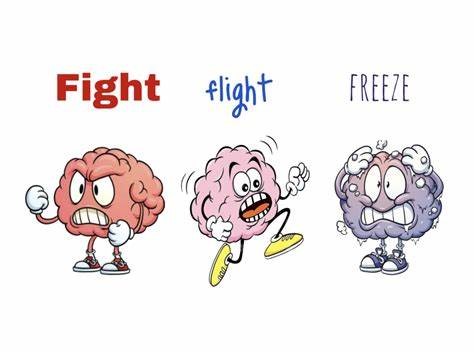
You are probably already aware of the phrase Fight-or-Flight but there are 3 other survival reactions when we feel threatened, Freeze, Flop and Friend which make up our defensive fear responses – also known as the five F’s.

When faced with danger each of the five F’s has its own hope for a possible outcome, that is to stay alive and depending on the nature of the situation, each of these defences reduce our being a threat to our attacker.

Our active defences are to;

  • Friend – to befriend our attacker in the hope of appeasing the situation
  • Fight – physically and verbally responding to the threat – showing aggression
  • Flight – to run away from the situation

Our passive defences are to;

  • Freeze – in order to avoid detection or you ‘just froze’ and unable to shout or call for help
  • Flop – to flop or feint; to minimise harm when you have no other option (as above) in the hope you will be left alone

In the modern world, that same mechanism can sometimes be triggered by everyday stressors or imagined threats. But understanding its origins can empower us to manage it more effectively. So, next time fear creeps in, take a deep breath, acknowledge it, and remember that your brain is doing its ancient job!

Categories
Addiction Children & Young People Difference between Counselling & Psychotherapy Featured Article Gender & Sexuality Grieving & Loss Marriage & Long-Term Relationships Mindfulness and Mental Health PTSD & Trauma Relationships

Is your counsellor a good fit for you?

There are so many counsellors offering a vast range of different therapies and approaches that it’s hard to know how to make the right choice, but it is so important that we do.

Finding the right counsellor, one who you can connect and feel safe with is important. Therapy can be a powerful tool for healing and growth, but only if you have a competent and trustworthy professional by your side. It can be difficult when we are feeling vulnerable and in need of help, to be confident enough to choose someone.

At Personal and Relationship Counselling (PRC) in Plymouth we offer a free 15-minute telephone consultation prior to booking a first appointment. Recommendations are good, but if you don’t have one, a telephone conversation can help and don’t be afraid to say ‘no thank you’, a good counsellor will be understanding – read about our counsellors on ‘Our Therapists’ page.

You can be assured that each counsellor has been handpicked, chosen for their competency and professionalism, empathy and compassion. We’ve checked their qualifications and experience, making sure that all are on the BACP Register of Counsellors and Psychotherapists or an equivalent professional body.

We offer a range of approaches and techniques to suit individual needs and find the fit that’s right for you. If we can’t meet your requirements, we will make recommendations of other trusted local Plymouth counsellors.

Here are some skills, traits and professional behaviours to look out for in your counsellor.

Good Counselling Skills:

  • Actively listening:  A good therapist will pay close attention to what you’re saying and ask clarifying questions. If you feel misunderstood or unheard – that’s a problem.
  • Focused attention: Does your therapist seem bored, tired, preoccupied or disengaged. If so, you’re not getting the focused attention you deserve.
  • Addressing Your Specific Concerns: Therapists should and be able to hear your issues and understand the impact they have on you, and tailor appropriate responses to meet your needs. If they seem stuck in one method or aren’t able to manage with your issue – you may need to find a better fit.
  • Non-judgemental:  Therapy needs to be a safe space to explore difficult emotions. If you feel judged or ashamed this isn’t going to help you – indicating it isn’t a good fit.
  • Working together: Therapy should be a collaborative process with your counsellor helping you to explore deeper and stay with the difficult feelings – rather than handing out simplistic, generic advice and platitudes.
  • Making progress: While you might experience some emotional discomfort processing difficult topics, you should generally feel some sense of healing and hope moving forward.

Maintaining Professional & Ethical standards:

  • Keeping to Appointment Times/Scheduling:  Having a regular time for your counselling is helpfulFrequent cancelling or rescheduling of appointments by your therapist shows a lack of respect for your time and can disrupt your progress in therapy.
  • Relevant Advice: Remember that therapists should stay within their area of expertise. If yours is giving medical, legal or financial advice – that’s not OK.
  • Confidentiality: Counsellors are required to keep your information private, with some exceptions. If you feel your therapist might be gossiping about you or sharing details inappropriately, that’s a concern.
  • Respecting Your Boundaries: If your counsellor shares too much personal information about themselves, pressures you to socialise outside of sessions, asks you for gifts or personal favours or makes unwanted physical contact – that’s a red flag.

Trust your instincts: Sometimes the chemistry just isn’t right. If you feel uncomfortable or unsafe with your therapist, it’s important to find someone else, someone you can connect with.  If you do notice any of the red flags and warning signs it’s time to look for a new therapist.

If you have any concerns, please feel free to contact us Plymouth Counselling (PRC).

Categories
Marriage & Long-Term Relationships Mindfulness and Mental Health PTSD & Trauma Relationships

Counselling for Armed Forces & NHS Staff in Plymouth

Feeling the Strain? Counselling Support in Plymouth for Those Who Serve

Are you a member of the armed forces, emergency services, NHS nurse or doctor, HM prison service feeling the weight of stress? You’re not alone. Plymouth is home to many heroes who dedicate themselves to keeping us safe and healthy. But even the strongest of us need support sometimes.

At PRC counselling practice on the Barbican in Plymouth, we specialise in providing confidential counselling and psychotherapy services tailored to the unique needs of service personnel and healthcare professionals. We understand the challenges you face, from the pressures of deployment to the emotional toll of daily emergencies.

Our experienced accredited therapists can help you with a variety of issues, including:

  • Stress and anxiety
  • PTSD (Post-Traumatic Stress Disorder)
  • Depression
  • Relationship problems
  • Work-life balance
  • Moral injury

We offer a safe and supportive space for you to explore your feelings and develop healthy coping mechanisms. We believe that everyone deserves to feel well, and we’re here to help support you in addressing your emotional wellbeing.

Here’s what sets us apart:

  • We understand your world. Our therapists have experience working with service personnel and healthcare professionals, and they are familiar with the specific challenges you face, both Steve and Nigel served in the armed forces.
  • We offer flexible appointments. We know that your schedule can be demanding, so we offer appointments at your convenience.
  • We are confidential. Everything you discuss in therapy will be kept confidential, except in limited circumstances where the law requires us to disclose information.

Don’t wait until you’re struggling to cope. Take the first step towards feeling better today with help from a counsellor or therapist at Plymouth Counselling.

Contact us for a free 15-minute phone consultation to discuss your needs.

Categories
Marriage & Long-Term Relationships Mindfulness and Mental Health PTSD & Trauma Relationships

Books Worth Reading About Mental Health

We’ve found the following books on mental health to be useful and want to share them with you.  Mental health has many facets and choosing a book is subjective, it depends on individual needs and preferences. However, considering the main counselling issues brought to us here at PRC in Plymouth, we regard the following books on the topic the most informative.

For understanding trauma and its effects:

  • The Body Keeps the Score: Brain, Mind, and Body in the Healing of Trauma by Bessel van der Kolk: This book explores the physical and psychological effects of trauma and offers evidence-based methods for healing.
  • What Happened to You? Conversations on Trauma, Resilience, and Healing by Bruce Perry and Oprah Winfrey: This book explores the impact of childhood trauma on mental and physical health and offers insights on building resilience and healing.

For managing anxiety and stress:

  • Maybe You Should Talk to Someone by Lori Gottlieb: This memoir by a therapist explores the experiences of both the therapist and the client, offering insights into therapy and mental health challenges.
  • The Anxiety and Phobia Workbook by Edmund J. Bourne: This practical guide provides self-help strategies for managing anxiety and phobias, including relaxation techniques, cognitive behavioural therapy (CBT), and exposure therapy.

For self-compassion and self-acceptance:

  • The Mindful Way Through Depression by Mark Williams and John Teasdale: This book teaches mindfulness-based cognitive therapy (MBCT) techniques for preventing and managing depression.
  • The Gifts of Imperfection by Brené Brown: This book explores the importance of vulnerability, self-compassion, and authenticity in mental and emotional well-being.

For navigating relationships and boundaries:

  • Attached: The New Science of Adult Attachment and How It Can Help You Find–and Keep– Love by Amir Levine and Rachel S.F. Heller: This book explores attachment styles and their impact on romantic relationships.
  • Set Boundaries, Find Peace: A Guide to Reclaiming Yourself by Nedra Glover Tawwab: This book teaches readers how to set healthy boundaries in their personal and professional lives.

For memoirs and personal stories:

  • The Noonday Demon: An Atlas of Depression by Andrew Solomon: This Pulitzer Prize-winning book explores the history, science, and personal experience of depression.
  • Eleanor Oliphant is Completely Fine by Gail Honeyman: This heart-warming novel tells the story of a socially awkward woman who learns to connect with others.

If you are concerned about your own mental health, it is important to reach out to a qualified mental health professional. Here at PRC counselling in Plymouth we can offer a range of therapists who you can book an appointment with, or have an initial 15-minute chat, just to find out whether we can help you or guide you.

Here are some additional resources that you may find helpful:

  • The National Health Service (NHS) has a website with information about mental health – NHS UK
  • Mind is a mental health charity that provides information and support – Mind
  • The Samaritans is a charity that provides emotional support to anyone in distress – Samaritans
Categories
Marriage & Long-Term Relationships Mindfulness and Mental Health PTSD & Trauma Relationships

The Signs and Effects of Gaslighting

Gaslighting is a term that has come to prominence in the last few years to describe behaviour in a toxic relationship. But what exactly is gaslighting, how can you spot it and how does it affect people?

What is gaslighting?

Gaslighting is a term used to describe a form of psychological abuse where one person or a group of people manipulate someone to question their own sanity, their memories or their perception of reality. It actually derives from a play and film, Gaslight, in which a husband convinces his wife that she has a mental illness. It can be carried out by more than one person, but it usually takes place within a relationship and can cause real distress and anxiety.

Signs of gaslighting?

There are many different ways that someone can ‘gaslight’ another person. Here are some things you should look out for if you are suspicious of gaslighting.

Countering – this is where your memory may be questioned. They may say things like, ‘That’s not what happened’, or ‘Have you forgotten how it really happened?’

Withholding – this is when a person pretends, they don’t understand what you are saying, in order to make you doubt yourself. ‘I don’t get what you are saying’, or ‘You’re not making sense’.

Trivializing – your reaction to a situation may be trivialised by another person and you may be accused of over-reacting or being too sensitive.

Denial – if the other person refuses to accept responsibility for their actions, blaming someone else or forgetting something happened, this is ‘denial’.

Diverting – this is when someone changes the subject or questions your thinking to make you think that it isn’t important or you have got the situation wrong.

Effects of gaslighting?

When you are the victim of gaslighting it can leave you feeling very insecure in your relationship. You may feel alone and powerless, convinced that you are the ‘crazy’ or ‘unstable’ one, when in reality it is the other person.

It will make you question everything. Your sanity, your memories and your ability to think rationally. You will also question the other person in the relationship – do you really know them? You will doubt yourself and your feelings, convinced that it is you that over-reacts and is too sensitive. If gaslighting happens over a long period of time, it can make you believe what the other person is saying and seriously doubt your own sanity.

Gaslighting enables the other person to exert their power and control over you, leaving you feeling lacking in confidence and deeply unhappy. Your self-esteem will be affected and you may also suffer with anxiety, treading on eggshells around the other person, never knowing what to say or think.

However, you look at it, gaslighting is a powerful and destructive form of manipulation that has no place in a healthy and balanced relationship. If you feel like you are being subjected to gaslighting, please get in touch if you would like to know more about how our counsellors at Personal & Relationship Counselling in Plymouth can help. Please give us a call or email and we’d be happy to answer any questions you might have.  

Categories
Addiction Marriage & Long-Term Relationships Mindfulness and Mental Health PTSD & Trauma Relationships

Addiction

At our practice in Plymouth, we’ve been supporting individuals in their journey to overcome addiction for many years—whether it’s related to substances or compulsive behaviours. These struggles often come hand-in-hand with challenges like depression, anxiety, or low self-esteem.

A lot of people approach addiction by focusing on the behaviour itself—trying to stop or abstain. And while this can work for some, digging deeper into the underlying reasons behind the addiction often leads to more meaningful and lasting results.

Renowned addiction specialist Gabor Maté, defines addiction as “a complex psycho-physiological process manifested in any behaviour in which a person finds pleasure and relief and therefore craves, but suffers negative consequences without being able to give it up. So; craving, pleasure and relief in the short term, negative consequences in the long term, and the inability or refusal to desist—that’s what addiction is.

He goes on to explain that addiction extends beyond substances like drugs, alcohol, or nicotine. It can encompass behaviours like shopping, pornography, sex, overworking, gambling, eating or even excessive use of the internet or mobile phones. “The issue is not the external target or the behaviour—the issue is one’s internal relationship to it.”

So, where does addiction come from? Well, it’s often tied to how we cope with stress and trauma. When life overwhelms us and we don’t have the tools to manage those feelings, we can turn to substances or behaviours that provide quick but temporary relief. It might be that extra glass of wine, staying late at work to avoid home stress, or compulsive online shopping after a hard day. These coping mechanisms feel like they work in the moment—but in the long run, they can lead to a cycle that’s hard to break.

Addiction isn’t the root problem—it’s a way to mask deeper pain. For many, that pain goes all the way back to experiences like neglect, abuse, or trauma in early life. Without healthy ways to process intense emotions, we might disconnect from them entirely. Over time, substances or behaviours can become crutches to help avoid those lingering feelings, keeping us stuck in a loop of addiction.

Breaking free means more than just stopping the behaviour—it’s about understanding and addressing the pain underneath.

If you’re ready to take that first step, our counsellors in Plymouth are here to help. We’re happy to answer any questions you have—just give us a call or drop us an email.

Categories
Addiction Gender & Sexuality Mindfulness and Mental Health PTSD & Trauma Relationships

The Problem of Loneliness Among Young People in 2022

Along with providing counselling and psychotherapy in Plymouth and online for adults, we at Personal and Relationship Counselling work frequently with teenagers. If you are a parent, or a teenager yourself, you will know that this age bracket – between 13 and 18 – encounters a unique series of challenges, such as exam stress, body dysmorphia, bullying, self-harm, gender and sexuality issues, and social anxiety.

When it comes to these aforementioned problems, there is an underlying factor that makes all of them worse: isolation. Being alone causes these issues to inflate and warp inside one’s head, and this is a particular problem with young people who are alone far more than their parent’s generation ever used to be, or even those in their twenties today. In this blog post, we will look at the two main reasons for loneliness among young people and how they have exacerbated mental health issues.

The Pandemic

While COVID-19 had far more serious implications for senior and vulnerable citizens, the effect of lockdown on teenagers was considerable and shouldn’t be ignored. Adolescence is a time for having adventures, making new friends, spending time with people outdoors. The pandemic and its enforced isolation meant that a generation of teenagers were unable to leave their rooms and meet friends for the best part of the year, which naturally led to some developing social anxiety and withdrawing into themselves.

In terms of the school environment, COVID-19 also had a deeply damaging effect. Not only is school a vital social hub where lifelong connections are made, that in-person teacher-student dynamic is so important for getting the most out of an education. Going from being in the classroom every day to doing everything online at home caused considerable stress, especially for those sitting exams. There is a whole age bracket – those who were 16 in 2020 – that did not sit GCSEs but have now had to face the stress of sitting A-Levels, with many understandably worried about handling an exam environment – which isn’t easy in the best of circumstances. Having to do everything at home, in front of a screen, without the company of friends or support of teachers, meant that loneliness became a considerable problem.

Social Media

Even before the pandemic, which dramatically increased our screen time, the overuse of social media was a major issue among teenagers. It is now the norm for young people to spend a major portion of their day in front of a screen of some kind – phones, TVs, tablets, or laptops. Some young people spend up to eight hours a day on their phones alone.

While there are benefits to connecting with others online, the main outcome is the extent to which it induces anxiety, low self-esteem, and a feeling of envy, or FOMO (Fear of Missing Out). Platforms like Instagram cause children to constantly compare themselves to others and, in turn, feel inadequate in some way. This is particularly the case with teenage girls, who find themselves endlessly subjected to unrealistic standards of beauty through being exposed to so many ‘perfect’ profiles on social media and in popular culture. Cyberbullying has also been a problem for years – especially on Twitter, Facebook, and Snapchat.

Social media, in this sense, consigns young people to their own lonely bubble, making them more susceptible to more serious problems like anxiety and depression.

At Personal and Relationship Counselling, we give young people a space to receive the precise kind of counselling in Plymouth or online that they need – with a specialist they feel comfortable with. Get in touch to arrange your initial consultation.


Categories
Featured Article Gender & Sexuality Marriage & Long-Term Relationships Mindfulness and Mental Health PTSD & Trauma Relationships

The People Repair Shop

There is a place in Looe Street whose people are a pleasure to meet. When you are emotionally depleted and utterly defeated; try to pluck up the courage, as they are wealthy in their knowledge, they are wise with words and you will be heard they refrain from opinion, you talk and they listen they are non-judgemental, they will be gentle you pause and they enquire, they will help you with your personal quagmire.

It is like a chat over a tea or a beer; but it doesn’t matter if you shed a tear there will always be a tissue, for whatever the issue. They will help you to value your life and restore belief, they are realistic and have the experience so, there will be no drama as they tend to your trauma. Take their counsel to ease your mind; you will not feel alone or left behind they have heard many things before but to them – your issue is unique and to no one else will they share or speak.

I share these thoughts and they are my own words.
In a few weeks’ time I will take my leave, but I would beckon you forward to take my place, as I wish for you also to have inner peace.

Annie Jenkin 2014